
Dioxins & Furans Testing
Dioxins and furans testing detect highly toxic environmental contaminants in food, feed, and environmental samples to ensure safety and regulatory compliance.

[Detailed Description ]
Dioxins & Furans Testing for Safety and Compliance
quantify persistent organic pollutants (POPs) present in food, animal feed, environmental samples, and industrial by-products. These compounds are formed as unintended by-products of industrial processes such as combustion, chemical manufacturing, and waste incineration.
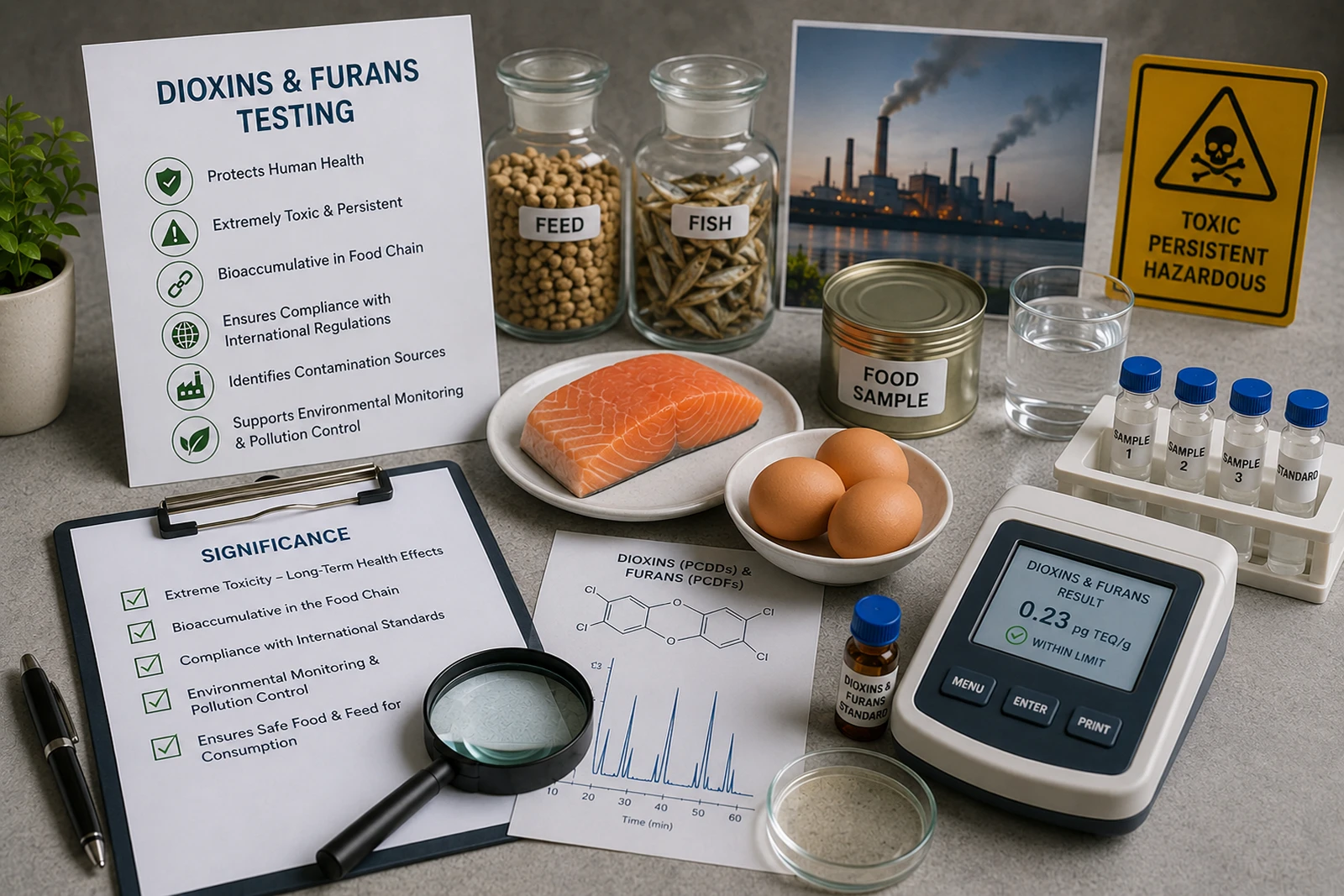
Due to their high toxicity, persistence, and bio accumulative nature, dioxins and furans are strictly regulated worldwide. They can accumulate in the food chain, particularly in fatty foods such as meat, dairy, fish, and oils, posing significant health risks.
Analysis is performed using advanced high-resolution techniques such as HRGC-HRMS, which provide ultra-trace level detection and high specificity for individual dioxin and furan congeners. Results are often expressed in Toxic Equivalency (TEQ) values to assess overall toxicity.
All testing is conducted using validated methods under ISO/IEC 17025, ensuring high accuracy, traceability, and compliance with international regulatory requirements.
Key Parameters Covered
Polychlorinated Dibenzo-p-dioxins (PCDDs)
Polychlorinated Dibenzofurans (PCDFs)
Toxic Equivalency (TEQ) Calculation
Significance
Dioxins and furans testing is critical due to their extreme toxicity, persistence, and ability to bioaccumulate in the food chain. Long-term exposure to these compounds can lead to serious health effects, including cancer, immune system damage, and developmental disorders. This testing helps ensure that food and feed products are safe for consumption and comply with stringent international regulations. It also supports environmental monitoring and pollution control by identifying contamination sources and enabling corrective actions.
[FAQ]
Frequently Asked Questions
What is Dioxins and Furans testing?
Dioxins and Furans testing is an analytical process used to detect and measure toxic persistent organic pollutants in food, feed, environmental samples, and industrial by-products.
Why is Dioxins and Furans testing important?
It is important because these compounds are highly toxic, persistent, and can accumulate in the food chain, creating potential health and safety risks.
Which samples are commonly tested?
Commonly tested samples include food products, animal feed, meat, dairy, fish, oils, environmental samples, and industrial by-products.
What is TEQ calculation?
TEQ, or Toxic Equivalency, is used to express the overall toxicity of dioxins and furans based on the toxicity of individual compounds.
Does this testing support regulatory compliance?
Yes. Dioxins and Furans testing supports compliance with international regulatory requirements and helps ensure product safety and environmental control.
Dioxins & Furans Analysis
Partner with BAS for precise dioxins and furans testing services to detect and quantify persistent environmental contaminants in food, feed, environmental, and industrial samples. Our advanced analytical techniques help ensure regulatory compliance, product safety, and protection of public health.